What to Track With Fibromyalgia (And Why It Actually Helps at Appointments)
You showed up to your last rheumatology appointment with the best of intentions. Then the doctor asked how your pain had been over the past month, and your mind went blank.

You showed up to your last rheumatology appointment with the best of intentions. Then the doctor asked how your pain had been over the past month, and your mind went blank. Not because nothing happened — a lot happened — but because fibro fog does not exactly make for reliable autobiographical memory.
This is one of the more frustrating parts of living with fibromyalgia. The symptoms are real, they are significant, and they change constantly. But by appointment day, the details have blurred.
A structured symptom log can help you hold onto those details. Not to self-diagnose, not to manage your own care — but to arrive at appointments with actual information instead of rough impressions.
This article is for educational and organizational purposes only. It is not medical advice.
Why Tracking Can Help
A fibromyalgia symptom tracker is not a medical device. It is a personal record — the same way a calendar helps you remember where you were, a symptom log helps you describe how you felt.
Here is what consistent tracking may help with:
- Noticing patterns your memory would miss
- Preparing for appointments so you do not go blank under pressure
- Giving your doctor a clearer picture of your baseline and how much it varies
- Identifying possible triggers over time
- Tracking how medications affect your symptoms across days, not just hours
- Building a record that is easier to share with a new specialist or for a second opinion
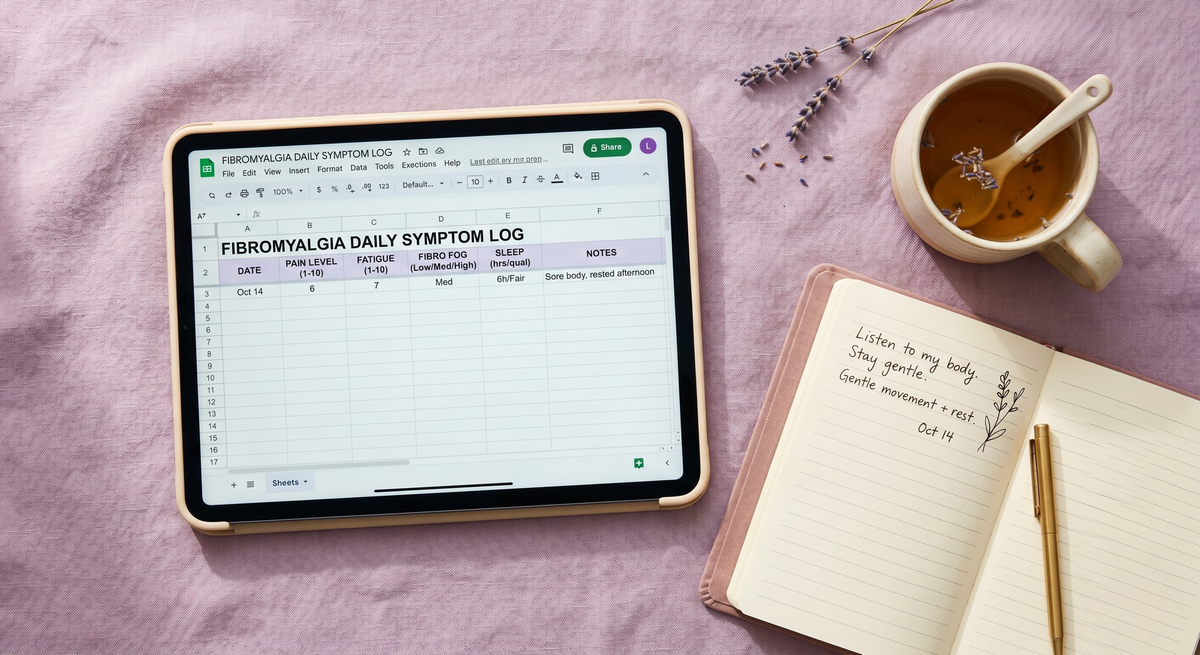
The CareLog Fibromyalgia Pain and Flare Tracker Bundle gives you a structured place to log daily symptoms, flares, triggers, medications, and appointment notes — all in one Google Sheets and Excel file.
Get the Fibromyalgia Tracker Bundle → PayhipWhat to Track
1. Pain Level
A simple 1–10 scale, logged once or twice a day, tells more than you think. The goal is not precision — it is range. A doctor needs to know if your pain averages a 4 with spikes to 8, not just "it varies."
"Pain level 7 this morning. Could not walk to the kitchen without stopping. By evening it dropped to a 4. Not great, but manageable."
2. Pain Location
Fibromyalgia pain moves. One day it is your shoulders and upper back. The next it is your thighs or hips. A pain location log can reveal whether certain areas flare together or in sequence.
"Right shoulder and neck today. Same as last Tuesday. Both hips and lower back — harder to sit."
3. Fatigue Level
Log fatigue separately from pain. Note whether rest helped, whether it lifted at any point in the day, or whether it was unbroken from morning to night.
"Slept 9 hours. Still exhausted by noon. Fatigue peaked around 2pm — could not concentrate after that."
4. Fibro Fog
Cognitive symptoms — difficulty concentrating, forgetting words, feeling mentally slow — are easy to underreport because they are hard to measure. A short daily note is enough.
"Struggled to follow a conversation this morning. Forgot what I was doing mid-task. Took twice as long to finish emails."
5. Sleep Quality
Note how many hours you slept and how rested you felt on waking. Fibromyalgia is often associated with non-restorative sleep — hours in bed do not equal hours of recovery.
"8 hours. Woke up at 3am and could not get back to sleep. Slept through but woke up feeling like I had not slept at all."
6. Flare Log
When a flare hits, note when it started, how long it lasted, how severe it was, and what was happening in the days before.
"Flare started Tuesday after grocery shopping. Lasted three days. Worst flare in a month — started the day after the family visit."
7. Possible Triggers
You may not know your triggers yet — that is exactly why you log them. Write down what preceded any significant symptom increase, even if you are not sure it is related.
"Did more walking than usual yesterday. Today is bad. Stressful phone call in the morning — pain escalated by afternoon."
8. Medications and Timing
Log what you took, when you took it, and any effects you noticed. If you are adjusting doses or trying something new, this record helps your doctor understand how the change played out in real life.
"Took pregabalin at 9pm. Felt groggy until 11am. Skipped one dose — pain noticeably worse by evening."
9. Weekly Symptom Summary
A brief weekly note — even two or three sentences — helps you see the bigger picture. Which days were consistently worse? Are there weekly patterns? Did symptoms improve, worsen, or stay flat over the month?
10. Appointment Prep Notes
Before each appointment, pull together your key observations. Write down your top two or three concerns, any new symptoms, and questions you want answered. A short organized summary is easier to hand to a doctor than a notebook full of daily entries.
How to Keep It Manageable
The most common reason tracking falls apart is that the system is too complex to maintain on bad days — and with fibromyalgia, bad days are not rare.
Three to five fields per day is enough. You do not need to fill in every category every day. A partial log is still better than no log.
The goal is consistency, not completeness. A month of brief daily notes is more valuable than two weeks of detailed entries followed by nothing.
Frequently Asked Questions
Does keeping a symptom log replace my rheumatologist or pain specialist?
No. A symptom log is a personal record, not a medical tool. It is meant to help you organize your observations so you can share them more effectively with your healthcare team. All medical decisions should be made with a qualified professional.
How much detail do I need each day?
As little as you can manage on a hard day and still have something useful. A pain level, a fatigue level, and one short note is enough. The goal is a consistent record, not a comprehensive one.
What if I miss a few days?
Pick back up where you are. A log with gaps is still useful. Trying to reconstruct past days from memory is less reliable and not worth the effort.
Can tracking help me figure out what causes my flares?
It may help you notice patterns over time — activities, sleep disruptions, or stressors that seem to precede flares. But fibromyalgia is complex and not every flare has an obvious cause. Use the log to organize observations, not to draw conclusions on your own.
My symptoms are getting worse. Should I keep logging?
Log if you are able to, but contact your healthcare provider. Worsening symptoms need professional assessment. A record of the progression may be useful for your appointment, but tracking is not a substitute for medical attention.
The Clearer Picture You Build Over Time
Your memory flattens everything. You remember it was a hard stretch, but you lose which days had flares, when the fatigue spiked, whether it came after exertion or arrived without warning.
Having your symptoms documented changes what you can say at an appointment. Instead of "I've been really exhausted," you can say: "My fatigue has been around a 7 for three weeks. I had two clear flares — one after grocery shopping, one after a stressful call. My pain location shifted from my shoulders to my hips by week two."
That version gives your care team something to work with.
The CareLog Fibromyalgia Pain and Flare Tracker Bundle includes 10 sheets covering the daily log, pain location tracker, flare log, trigger log, medication tracker, appointment summary, weekly symptom tracker, and a dashboard — in Google Sheets and Excel.
Get the Fibromyalgia Tracker Bundle → Payhip